Friday, April 13, 2012

CISPA: Worse than SOPA & PIPA?


“Be worried: they think we stopped paying attention after SOPA -- so they made this.
The Cyber Intelligence Sharing and Protection Act has support from companies like Facebook, IBM, Microsoft, Verizon and more. So what is it?

Violet Blue sums it up as, “CISPA's primary function is to remove legal barriers that might keep Internet companies from giving all your communication and information to the government. It allows "cyber entities" (such as Internet service providers, social networks like Facebook and cell phone companies like AT&T) to circumvent Internet privacy laws when they're pressured by Homeland Security to hand over or shut down -- well, almost anything of yours online that the government wants, no warrant needed.

So how does this affect piracy? Because of the wording in the Act it will allow the US Government to take action against sites such as The Pirate Bay and Wikileaks. Is this right or wrong?

Violet Blue also describes CISPA as, “CISPA is primarily a surveillance bill. With CISPA, a company like Google, Facebook, Twitter, or AT&T could intercept your e-mails and text messages, send copies to one another and to the government, and keep it from being sent if it fits into a plan to stop "cybersecurity" threats.

What are your thoughts? Do you think CISPA is the same or different from SOPA & PIPA?


Monday, April 9, 2012

Did You Know That..


http://www.dga.org/Craft/DGAQ/All-Articles/1001-Spring-2010/Internet-Issues-Piracy-Statistics.aspx
http://www.flickr.com/photos/will-lion/2644981247/
http://www.bsa.org/country/Anti-Piracy/What-is-Software-Piracy/~/media/D02B5A4B60444B0AAF6CFDD598C72CBC.ashx

Wednesday, April 4, 2012

Internet Service Providers to Punish Piracy?


Internet Service Providers (ISPs) are discussing implementing a system that will “punish” suspected piracy activities. ISPs will accomplish this by sending “educational copyright alerts” that are meant to inform the user of their suspected pirating activity. If the user ignores the alerts the ISP may use Internet speed throttling which limits the user’s internet access; and then require the user to meet with the ISP to discuss the pirating activity. There are no plans to prosecute users who continue to pirate.

There are multiple views on the matter, two are quoted below:

“"We anticipate that very few subscribers, after repeated alerts, will persist (or allow others to persist) in the illegal behavior," according to a statement on CCI's website. According to the statement, Lesser joined the project because it's "centered on education and deterrence, not punishment."

“Not everyone agrees. The Electronic Frontier Foundation, a group that defends Internet users' rights, wrote that "an alert represents nothing more than an allegation untried by a court. We think loss of Internet access would be a draconian measure that Congress did not intend."

What are your thoughts on the issue?

Piracy in the news:

Recently i’ve discovered that former file hosting service giant megaupload.com, who in the past few months has been indicted for assisting in the practice of online piracy, has been facing another serious issue that relates directly to its subscribers. According to the article on Cnet, when the Megaupload was shut down and its servers were seized, the original intent was that the data contained within the servers would be preserved (by request of the MPAA) in order to assist in possible future civil suits against Megaupload. However, as of late, there is a chance that the all of the data in question may be deleted, regardless of its legality status.

The reason I have a problem with this is because, in spite of the piracy activities associated with this service, the users who uploaded data that belonged to them or was legally obtained should be given access to that data. But now the real question comes, how do you feel this situation is being handled?

Cnet - Megaupload users out of luck

Wednesday, March 28, 2012

Jokes On You!

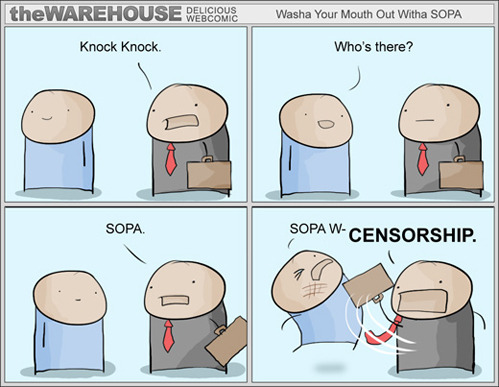
We found some funny pictures about SOPA/PIPA and thought we'd share! Share your thoughts on any of these pictures or post some of your personal favorites! Enjoy!
http://theuniblog.evilspacerobot.com/?tag=sopa
http://www.washtenawvoice.com/wp-content/uploads/2012/02/sopa-pipa-cartoon-1000x651.png
http://funny-pictures-blog.com/wp-content/uploads/2011/09/SOPA-and-PIPA.jpg
http://24.media.tumblr.com/tumblr_lxrjmypgna1qewacoo1_500.jpg

Monday, March 26, 2012

Would you Pirate a cd/dvd/eBook that a Friend Produced?


This past weekend my friend’s band released their first CD and sold it for $12. This got me thinking; who would pirate something their friend produced? Come to find out my friends and I will not; most of us bought our own copy of the CD and as far as I know none of us plan to pirate it.

I realize that this may not be the best example because they are just starting out, but even if they hit it big there would be no way I would pirate their music. Who steals from their friends?

I challenge everyone to do the following: When faced with the option of pirating pretend it is your friend’s piece of work and maybe that will cause you to change your mind about pirating.

Do you think this will help prevent you from pirating? Would you pirate something your friend produced?

Wednesday, March 21, 2012

Piracy and Television

Television, being a prevalent media outlet that people frequently turn to piracy for, is pirated for two main reasons. People either do not have easy access to their favorite shows or simply do not wish to pay to watch said shows. To be honest, in the past i would have looked the other way on this issue but because of the availability of several streaming, rental, and pay services as of late, I find I cannot excuse this practice anymore. Prior to the release of services like Netflix, Hulu, or the TV section of iTunes, people were basically forced to wait until shows were being sold in retail stores or choose to pirate them.

However, we now have access to all of our favorite shows on demand, the only requirement being a small payment, ranging anywhere from a 2 to 10 dollars. Because of the value in these resources, there is no valid excuse for an individual to continue to look to piracy as an outlet for television. In fact, I know that at least one pirating/ downloading project "TVShows" (no space) was dropped by its original creators and staff because of the addition of current tv shows to iTunes vast library. So there you have it, even former pirates themselves admit that given the opportunity and an affordable pricing model, people will choose to acquire digital media in a way that is legally right.

And for your convenience I've listed here a number of services I have mentioned that will allow you to watch just about any current or syndicated tv series.  

Hulu
Netflix
Amazon Instant Video

Monday, March 19, 2012

PYFP!!!

What is PYFP?? Just an acronym that we came up with for Protect Yourself From Piracy.
We have talked about piracy and how people are against it and how many differet types there are, so we thought we would inform you that there are steps and precautions you can take to protect yourself from piracy.

You can:
-purchase from a known and trusted source
-make sure that the product is authentic and genuine when you purchase a software, movie, music, etc.
-activate and register the product if necessary
-respect intellectual property rights laws
-understand key facts about licensing laws

These are a few important steps/precautions you may take to PYFP. There are a whole lot more ways you can protect yourself depending on what kind of product you purchase. Here are some sites you can visit so that you may be able to undersand ways you can PYFP:
-Microsoft: http://www.microsoft.com/piracy/
-Adobe: http://blogs.adobe.com/photoshopdotcom/2011/07/protect-yourself-from-pirated-and-counterfeit-software.html
-Rosetta Stone: http://www.rosettastone.com/global/anti-piracy
-Symantec Corp: http://www.symantec.com/about/profile/antipiracy/tips.jsp

If you have any tips of your own or find an important one through some of the websites or anything at all, please, feel free to share your thoughts by commenting! =D

Wednesday, March 14, 2012

With the rise of eBooks comes the rise of eBook Piracy


We have all heard about music, movie, and software piracy; but who has heard of eBook piracy? EBook piracy has been on the rise, mainly because of the rise in the amount of eBooks becoming available. Some estimate that eBooks will make up 50% of the book market in 5 years!
What makes eBook piracy scary is the size of an eBook; only a couple of megabytes. In the link below, David Carnoy talks about how his eBook was part of a 2,500 eBook Torrent; this Torrent was only 3.4GB! Let’s look at this from a monetary standpoint; at $4 an eBook that makes this Torrent worth $10,000! Those couple of CD’s you illegally downloaded does not sound so bad now.
Lastly, we will look at how eBook piracy hurts authors more than music piracy hurts musicians. Scott Turow, the President of the Author's Guild, puts it perfectly; "It [piracy] has killed large parts of the music industry," he said in an interview. "Musicians make up for the copies of their songs that get pirated by performing live. I don't think there will be as many people showing up to hear me read as to hear Beyonce sing. We need to make sure piracy is dealt with effectively."
What are your thoughts on eBook piracy? Does it matter? Do you care?


http://reviews.cnet.com/8301-18438_7-20033437-82.html 

Tuesday, March 13, 2012

Opponents and Proponents of Piracy

According to the list I procured, I discovered that there are at least 124 notable organizations that pledged support for the SOPA act, while 168 notable organizations were listed as being in opposition of this act.

Let me first examine the proponents. I know what you're thinking, how could a practice that is clearly illegal have such a high number of supporters (or organizations who support the freedoms that piracy represents). I am sure you would be surprised to find that names like Amazon, Microsoft, and The New York Times all share space on the list of SOPA opponents, along with sites like Twitter or Facebook. Of course this list also includes an organization by the name of The Pirate Bay, which gives people access to any materials or data (copyright or not) that its users submit. Though these institutions all have varying degrees of involvement in the issue of piracy, they all chose to voice their grievances against acts like SOPA and PIPA.

Now lets examine the opponents of piracy (or organizations who support legislation that is created to limit and prohibit anything piracy-like). On this list, i was quite surprised to find names of a few professional sports leagues, Nike, and even Revlon, a cosmetics company. What didn't surprise me was that the majority of organizations on the list were either in broadcasting (ABC, CBS, ESPN) or media (BMI, MPAA, and, Sony Music). Considering these are the sources of materials being pirated i would expect nothing less of them then to unabashedly support and proselytize acts like SOPA.

Now its your turn to decide for yourself will you be for, against, or perhaps neutral??

My source: https://en.wikipedia.org/wiki/List_of_organizations_with_official_stances_on_the_SOPA_and_PIPA

Wednesday, February 29, 2012

SOPA What? PIPA Who?


Everyone have their own reasons to pirate, and most of us are like, "So what’s so wrong about ripping a CD/DVD for a friend? I'm just sharing and it doesn’t hurt anyone." WRONG! Pirating is basically stealing someone else’s property so that makes everything just wrong. It’s a crime, just like stealing a car from a parking lot or taking cash from a register, you’re hurting the owner by stealing his/her ideas or properties. Every crime has its own punishment, but for pirating, it includes, but not limited to, a free trip to prison and a nice big fine—I guess that doesn’t make it a free trip. So what is the government trying to do to stop these crimes or reduce pirating? The government is trying to pass some new laws or bills to prevent any online piratingbut that failed. We’re sure you’ve heard about SOPA (Stop Online Privacy Act) and PIPA/PROTECT IP (Preventing Real Online Threats to Economic Creativity and Theft of Intellectual Property Act) right? Kinda? Sorta? I don’t care? 

Well, SOPA and PIPA are aimed to stop foreign-based websites that sell pirated movies, music, and other products by stopping U.S. companies from providing funding, advertising, links or other support to the foreign sites. In short, SOPA and PIPA may lead to censoring of the Internet and weakening of online security. These bills have caused social websites, like Facebook and Reddit, and other websites, like Wikipedia and Google, to protest and oppose the bills. Not just websites that opposed the bills, even three officials under President Obama's administration opposed it. Those officials issued a statement stating that “online piracy by foreign websites is a serious problem that requires a serious legislative response, but the administration would not support legislation that reduces freedom of expression, increases cyber security risk, or undermines the dynamic, innovative global Internet.”

Even though the officials did make that statement, it still sounds like they want to find a way to work around all these protesters and make everyone a happy camper. In regards to the officials’ statement, how do YOU think the government (government? huh? what’s that?) should stop pirating or should they just embrace pirating since it’s going to keep happening anyways? Feel free to tell us how you feel or vent if you want to because we like to hear what you have to say!

Ribeiro, John. "Wikipedia, Craigslist, Other Sites Black out Against SOPA at Midnight." PCWorld.com. PC World, 18 Jan. 2012. Web. 29 Feb. 2012. <http://www.pcworld.com/businesscenter/article/248324/wikipedia_craigslist_other_sites_black_out_against_sopa_at_midnight.html>

Schatz, Amy. “What Is SOPA Anyway? A Guide to Understanding the Online Piracy Bill.” The Wall Street Journal. Dow Jones & Company, 18 Jan. 2012. Web. 27 Feb. 2012. <http://online.wsj.com/article/SB10001424052970203735304577167261853938938.html>.

Monday, February 27, 2012

Why do YOU choose to pirate music?


                The most recognized form of piracy in our opinion is music piracy. Have you ever illegally obtained music? Yes? No? Unsure? Here is a simple test; if you answer yes to any of the following questions then you have been a music pirate.

1) Have you ever downloaded music without paying for it?
2) Have you ever burned/ripped a CD for a friend?
3) Has a friend ever burned/ripped a CD for you?
4) Have you and a friend bought a CD together?
5) Have you ever ripped a CD to your computer and then sold the CD?

The truth is you would be hard pressed to find someone who has never pirated music, so why might one do it? Listed below are a couple of reasons one may pirate music, do you think these reasons are excusable or inexcusable? Have you or a friend ever used these reasons to pirate music?

                1) Music costs too much.
                2) It is easier to download it for free.
                3) The artists have enough money.
                4) The record companies have enough money.

 What other reasons might someone pirate music?


Wednesday, February 22, 2012

Piracy and Morality

Now that you know what piracy is and what it can look like, let's examine the aspects of this topic from a morality standpoint. i.e. What about and what of piracy is inherently wrong or right? By definition most people would automatically assume that this act is not only unlawful, but also unethical. However, this is not always the case. Take for instance, someone finds that one of their favorite cd's is beyond repair. Having purchased it recently, they are less than eager to purchase the cd again, so they decide to download the cd from a torrent website. Or another case, in which a group of people purchase cd's on an alternating basis and then burn and distribute copies amongst themselves in order to save money on music.

Technically both of these examples are instances of piracy, but could be construed as being different degrees of this offense. In the first case, less people would be phased because this behavior has become so prevalent. In the second case however, i would bet that more people would be uncomfortable being involved in such conduct. Also, in both of these cases, I am quite certain that the individuals involved did not give a second thought about what they were doing to get that music. When gaining new media requires so little a cost nowadays, people are more likely to bend the rules in order to keep up with all the latest flavor of the month or grammy winning artists.

Lastly, i should mention that these opinions are completely relative and up to interpretation. That is ultimately the point of this blog. And to finish this post I thought i would end with my least favorite ad on piracy that we all have to sit through every time we watch a dvd. Courtesy of all those film studio execs who make more money than they know what to do with.


Thursday, February 16, 2012

What IS piracy?

For those who don’t know what piracy is, it’s an illegal and criminal activity that involves stealing someone else’s intellectual property—that is music, movies, software, etc.—and sharing it with others. Piracy has been an ongoing threat to business ever since people started trading with other countries. The word piracy originated from way back when sea trading was big in business and pirates, robbers of the sea, would seize goods from other ships for themselves.

Piracy has come to mean many different things over the years. Other uses for the word piracy have occurred in the late 20th and early 21st century, mostly relating with the stealing and reselling or distributing of electronic media. There are various forms of piracy and can be committed in various ways. Some most used forms of piracy are Internet piracy, optical disc piracy, computer piracy, and software piracy. The problem of piracy has arisen with the rapid advance of technology, making it easy for the pirates, the people who choose to play a part in stealing or copying digital media, to carry on their illegal activities.

USPTO. "Kids - Stop Piracy." United States Patent and Trademark Office. Web. 16 Feb. 2012. <http://www.uspto.gov/web/offices/ac/ahrpa/opa/kids/kidantipiracy.htm>